Wednesday, March 30, 2011

Econmonics for Afghanistan

Some of the huge figures that are tossed around when discussing the war in Afghanistan are hard to really appreciate. How does one put into context a sum on the order of trillions of dollars? One has to wonder - how could costs have gotten so high? Does anyone in Washington really care about the long-term effects of spending such ungodly sums of money? Imagine what could be accomplished if that money were spent on constructive endeavors, instead of on bombs and killing people...

The military claims to attempt to cut costs by outsourcing certain services to contractors. These contractors in turn, sub-contract these services - often hiring local groups and paying them a small fraction of the contract amount, and then simply pocketing the remainder as profit. This makes me strongly question why the military bothers at all with these middle men - why not simply hire Afghans to help re-build Afghanistan? This was something that was touched upon in the film we watched in class "Re-thinking Afghanistan" but I think there's a lot to be said about this issue. It seems that we - America - are perfectly content with being taken advantage of allowing war profiteers to get rich off the blood and sweat of other Americans. We really must re-think how the spending for the war is managed.

It's understandable (though not necessarily forgivable) that the military would spend money carelessly - after all it really isn't there money. Congress is just as much a guilty party here as any for not putting restrictions on the spending power of our war machine, but rather than focusing on whose incompetence is greater, I'd like to just tie this issue in with something I've brought up before - economic growth in Afghanistan. I firmly believe that the rise of terrorism, militantism and islamism is directly related to the desperate economic conditions in the region. It's understandable why people would be angry with America, and even hate America, but being willing to take up arms and die fighting America is an entirely different thing. Che Guevara's revolution failed because he could not motivate enough of the lower class to fight - and the reason being was they had too much to lose. They may have been poor, but they had food and land and homes - guerrilla warfare stems from desperation.

This is not the case in Afghanistan - there is plenty of desperation to go around and that means plenty of young men willing to risk their lives fighting the Americans for what meager pay the Taliban would offer them, or simply because they feel they must do something to change their situation. There are more factors involved here than poverty however - fundamental ideological differences between the Islamic world and the West make Western occupation of Afghanistan a very difficult pill to swallow, and the sense of wanting revenge for past and present crimes against the people of Afghanistan, however, I feel the ultimate motivating factor is economic. Give people jobs, a chance to support their families and a sense that their lives have some worth, and I think one would find it is much more difficult to convince people to take up arms and run off the mountains.

And with all the money and resources being wasted on contractors and U.S. troops in Afghanistan, we could be helping to provide jobs for the Afghans, by hiring Afghans to construct wells, build roads, and provide security. The added benefit is it would be orders of magnitude cheaper to pay an Afghan - who would be happy to work for a tenth of what an American would - to do the same job as an American, and at the same time you have just eliminated one enemy combatant with zero loss of life. It is a win-win situation. Of course, there is still a need for some American presence to oversee reconstruction, manage funds and recruitment, provide training and supplies, and all the other administrative duties - but that would be far less costly than managing a full war. It just doesn't make any sense to continue spending billions on fighting and killing people, when we could probably solve our problems in Afghanistan for a fraction of the cost, and of greatly reduced loss of life to both Americans and Afghans - and secure a stable future for the country which has been left in ruins following thirty years of warfare.

I sometimes wonder if as an institution the military purposely perpetuates warfare so as to ensure it's own survival. That's probably not true, but it sure feels like that sometimes. I think what we really ought to do is fire most of our military commanders, and instead bring in some economists to manage Afghanistan. It's clear the Afghan people are not pushovers, we can not bully them into submission, which means we are forced to work with the Afghan people - not impose upon them a solution which is convenient for us. I could be wrong, but this is the type of solution that seems to be needed - not drone attacks or special operation forces. I just hope that the damage isn't so great that Afghanistan isn't doomed to forever be a failed nation...

Friday, March 25, 2011

Myopia

In the discussion today one issue was briefly mentioned which I think is a huge problem in American politics and highly relevant to the wars in both Afghanistan and Iraq - the reluctance for politicians to see the bigger picture, and to base their decisions on the long-term rather than the short.

One can find examples of this everywhere, but in keeping this relevant to the war you could look at the Reagan Administrations funding of the Mujahideen during the Soviet invasion, and their subsequent "abandonment" of Afghanistan after the Soviet withdrawal. The short term-goal was to cause problems for the Soviets, which we did. No thought was given to what affect arming rag-tag militias might have on the long-term, and when the Soviets left, no thought was given on what was to become of Afghanistan. Where there are no short-term gains, it seems America is reluctant to act.

Even in the present decade, the focus of Iraq and the under-focus on Afghanistan by Donald Rumsfeld showed extreme short-sightedness. Going beyond the scope of this discussion, alternative energy, investment in scientific research and development, improving education and many other issues with great potential for enormous gains over the long-term are often pushed aside for the more expedient ones. The private sector understands the long-term, the government seems to not. That's really not that surprising though.

When a President, or Congressman enters office, one of the things that must constantly be on their mind is to do all they can to help ensure their re-elected in the next four or two years. From the moment they step into their position they are in a short-sighted mindset. This is an inherent feature of the way our government works, and it certainly is major oversight, in my opinion, by the architects of our country. From an economists point of view, there is almost no motivation for a President or Congressman to support a policy or legislation which does not have any short term gains, or worse yet may have short term losses, despite how great the gains may be in the long-run. Apart from running the country, Congress and the President must also constantly be nurturing their careers, and that means focusing on public opinion now not thirty years from now when, with clarity of hindsight, people may look back fondly on their foresight.

I really don't believe that the American government is stupid, and if I can reason about the long-term than so can they. They do, however, have to make conscious choices about not only how their decision affect the country, but how they affect their own careers. For example, suppose Bush was able to see that invading Afghanistan may result in a huge mess (this is, however, extremely unlikely although I'm sure people around him did) ten years down the road. A man who is only motivated by the interests of the country might reassure his people, who are calling for blood, and attempt to convey the difficulties involved, despite the enormous criticism he may receive. A man motivated by self-interest, however, would see this as an opportunity to show himself as a strong leader and gain large popular support, despite the damage is may cause after he's long gone from office.

This is a problem to me. It's not a problem with the people in government - it is only human nature to want to preserve your own interests - but it is a problem with the structure of the government its self. I suppose the idea originally was prevent the emergence of monarchies and rule by succession that had dominated Europe for hundreds of years, but these things are almost entirely a thing of the past in western society. Is it reasonable to assume that a system which was designed to address the problems of the 18th century will remain adequate for the modern world? I don't think so, and I would propose modifying the way we think about terms and election to address the weaknesses that are beginning to show themselves as the world around us changes.

I would propose eliminating consecutive terms, and merging a president's term to a single term of eight (or possibly ten) years, with no chance for re-election. This really has no disadvantage over the current system (except for keeping bad presidents in power longer, but it seems that two consecutive terms is a growing trend, regardless of actual performance). This at least liberates the President from having to worry about his immediate political future and perhaps some incentive to take political risks which may pay off in the long run. I would propose the same sort of idea for congress as well.

It may be naive to assume that this would have any real effect, and I'm certainly not claiming that my simple suggestion is all it would take or is the only possible solution, but what I am firmly saying is I feel that this is a real issue in American politics, and one which seems to be responsible for many of crisis we face in the coming years (terrorism, climate change, oil and energy, our technological superiority, and the list goes on...), and a blatant example now of the failure of foresight is Afghanistan. The lessons of history are there to be heeded or ignored, and I sincerely hope that common sense will prevail.

Tuesday, March 8, 2011

We Do Not Negotiate With Terrorists

We've talked in class about how the most likely resolution to the war in Afghanistan will be some sort of political settlement following a negotiation with the Taliban. We also discussed how presidential politics can influence the conduct of the war and a presidents decisions regarding it. So I wonder, where, when and how are these two facets of the war going to meet? Allow me to elaborate.

In the beginning, the Bush administration wanted to paint a direct connection between Al Qaeda and the Taliban, which may or may not be fair, but I believe they also took it a step further and tried to paint the picture - or at least strongly imply - of a direction connection to the Taliban and the September 11th attacks, which of course is ridiculous. Since that time the American public has remained largely ignorant of who the Taliban are, the history of Afghanistan and the events of the war it's self. If asked who the Taliban are, I think it's fair to say, most people would say "terrorists", or something closely along those lines. (I called my sister up and asked her this question and she responded as I expected). If this is the general perception in America, how is it going to look when we try to begin talks with these "terrorists"? Which President is going to be the guy who "gave up" as will certainly be the impression the opposition partly will attempt to paint?

I think by vilifying the Taliban and labeling them as essentially the same as Al Qaeda, it makes bringing the conflict to an end significantly more complicated. The war in Afghanistan remains unpopular, but not nearly as much as Iraq was, and I think generally most people forget we're even there in their day to day lives. I don't feel that there is any real pressure for a President to seek a quick end to the fighting at the expense of dealing with the shit storm certain people will stir up over the thought of negotiating with these radical jihad waging muslims. I can only begin to imagine the headlines FOX news would begin coming up with. With President Obama already having been accused in the past of  being sympathetic to the Muslim world (which many Americans, ignorant as they may be, group broadly as an enemy of the United States with little distinction between countries), I don't see how he could ever realistically offer some kind of deal to the Taliban and ever have a chance of being re-elected.

I may be misjudging the American public, but to me it seems that negotiations with the Taliban will put a very bad tastes in the mouths of people who've for ten years have learned very little about Afghanistan and mainly rely on the U.S. media which generally doesn't make any distinction between the Taliban and a true terrorist organization. Even if you accept the Taliban aren't terrorists, still many people take issue with their treatment of women, their brutality toward the Hazara and other genuinely horrific acts they've committed. It seems we're stuck fighting an enemy we can't defeat militarily, and whom we can't compromise with politically. It's a very tricky situation.

An ideal solution would be if we could begin to withdraw and let the Afghan government handle the talks - in that way the American leadership would be somewhat shielded from accusations of caving to the Taliban or something along those lines. In order for that to happen though, it would require that Afghanistan build up a strong army capable of maintaining the government in the event of continued fighting - otherwise if America withdraws the Taliban would have little insentive to negotiate if they sense they can defeat the Afghan government - in which case we've come full circle back to the civil war of the mid 1990's.

So while the fighting continues on the ground, and all of the vast challenges that face Afghanistan, it seems if America wants to end its involvement there soon we have to not only find a way to begin talks with the Taliban but perhaps more challengingly find a way to make those talks politically palatable at home. Nothing is easy about Afghanistan...

Tuesday, March 1, 2011

The Progress of War

 This is something that came up in class today which got me thinking. During lecture, the Professor (YOU) posed the question of how one measures progress in an unconventional war. The comparison was made to that of a conventional war where you may have a clearly defined front or some position you wish to advance on (a city, a bridge, a hilltop) and progress is measured literally in yards and movement of the front.

In an unconventional war, the argument was made, goals are not always so clearly defined and there is no defined "front". Winning a battle may mean very little, and result in no gain, save perhaps your side killed more than their side did. So can one measure "progress" in a war where goals are at times ambiguous and in a country which has experienced thirty years of continuous warfare? Well I think you can, however even the best "measurements" of progress under such circumstances are only really indicators of progress. Still, I think its necessary to evaluate progress in somehow, because how else can you plan for the future if you don't know where you stand now?

First in order to measure progress, one has to know what they are supposed to be progressing towards. In Afghanistan, I think one can state our main goal there fairly simply as such:
To establish a stable, democratic and pro-American government capable of running the countries affairs and maintaining internal stability. 
Those are my own words, not the military's, but I think that's a pretty fair assessment. No doubt there are other goals and agendas, but I think the above is the main overarching goal in Afghanistan. If that's the case, then one needs to consider how is such a goal achieved or how is it prevented. To establish a stable state, this generally requires there aren't large numbers of insurgents who are actively fighting the government. This is itself a complex issue - who exactly is an insurgent, how do you combat insurgency effectively and prevent it from re-emerging? The latter is a clearly part of the larger goal, and I think that is where progress is made and measured.

First though, allow me to give my answer to the question "who is an insurgent?". I think an insurgent is quite simply anyone who is willing to pick up a gun and fight against the government or the U.S. military. There may be complex and important social factors that play into why that person chooses to fight, but as far as the issue from an American perspective is concerned, if you are willing to take up arms against the Afghan forces then you are an insurgent. As mentioned above, progress will only come when the insurgency dies down, however that may happen. So a measure of the progress of the War in Afghanistan I think (and this may be simplifying things greatly) is a measure of the status of the insurgency. If there was no one to fight, we'd have no reason to continue staying there.

In this regard, I think progress is measurable. One can talk about the success of "reintegration" programs - programs that are designed to get young men to put down their Kalashnikovs and rejoin society (and one can debate what "Afghan society" actually means, but that's another blog post). I think it's much more tempting to give up the resistance and go home when you aren't facing arrest for doing so. The fact that these programs even exist is surely a sign of progress, and the expansion and spread of these programs will indicate progress.

Relations with influential groups is another important indication of progress I believe. Negotiations and ultimately a political settlement with the Taliban is admittedly how the war is likely to end, and so any kind of talk or debate or building of a dialogue is progress. Unfortunately that doesn't seem to be happening yet, but when and if it does it will surely be a step towards ending this conflict. The trickiest aspect of all this, however, is how to prevent the insurgency from returning. There is an ebb and flow to these things, and while one might be able to stamp out resisitance for a period of time and declare "Mission Accomplished", if the insurgency re-emerges then you are back to square one. Preventing further fighting and insurgency is a huge part of achieving our goals, and is probably the true step toward progress.

I think even here though one can make some generalizations. Economic opportunity is a huge problem in Afghanistan - that is the lack thereof. It's tempting to go off and fight when you're frustrated with your situation in life and have no job prospects or really any hope of improving your life. When you have a good job though and are able to make money and raise a healthy family, suddenly running off to the hill to wage jihad doesn't seem so appealing. I think the ultimate progress in the war will come from economic progress - and that won't be easy. In my opinion, America is going to have to do some nation building if its ever going to give these men some incentive to support the government. It's one thing to support a government who is providing jobs and a chance to earn a living, it's entirely something else to support a government who seems to do nothing for you and which you view as an affront on your freedom and way of life.

So while even at best, the situation is not black and white, I feel that one can draw conclusions about the progress we're making in Afghanistan and if you examine things closely you'd probably be forced to conclude that so far, it ain't much.

Friday, February 25, 2011

Restrepo

Restrepo is a great piece of journalism. It offers a not often seen glimpse into the day to day lives of the soldiers stationed in Afghanistan, and I think it does a far better job of showing the reality of the war than the U.S. media. It doesn't attempt to directly state anything and I think offers an unbiased view, as much as is possible at least, given that it is shot only from an American perspective for obvious reasons. Still, several key themes stand out throughout the film, and it is a candid look into the experience and the views of Americans stationed over there.

The first thing that struck me is how lush and beautiful the Korangal Valley is. I suppose you get the impression of Afghanistan as this harsh, dessert wasteland, but the Korangal isn't too much different than the American southwest. Another striking feature is just how rough the terrain is. Afghanistan is infamous for being mountainous, but it's not until you see the villages dug into the sides of the hills and the sharp maze of "spurs" that you really appreciate that this is not an easy land to navigate. The beautiful landscape is soon contrasted with the ugliness of war, and the frequent skirmishes between the Americans and the Taliban become a daily part of life.

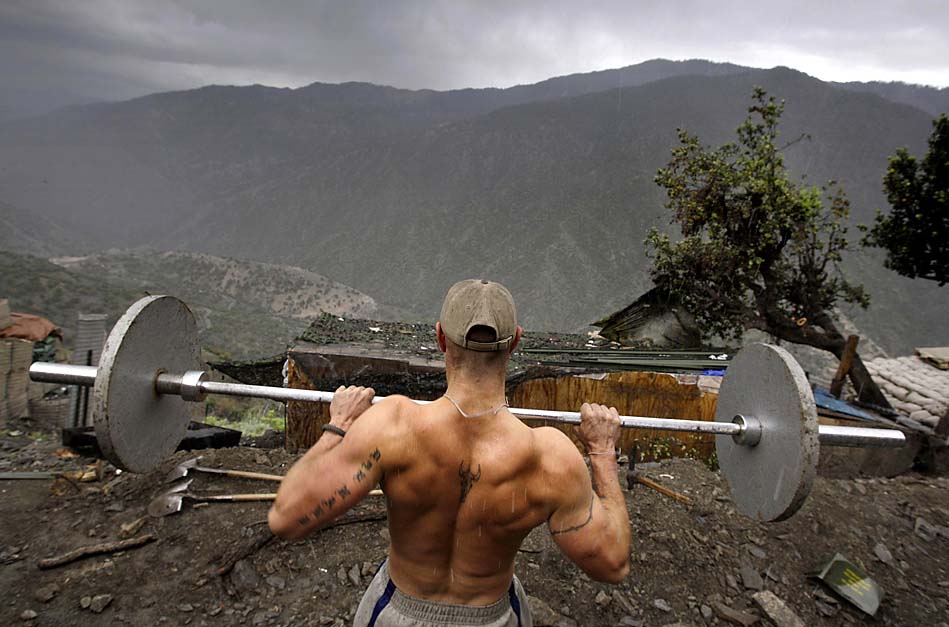
Lack of Infrastructure: This is one of the major themes in the film. Most of the time spent with the Americans takes place in a little hovel of a base called OP Restrepo. It was built ontop of a hill by the Americans using picks and shovels. They have no running water, no electricity, and very little in the way of any sort of modern comforts. It's somewhat surprising to think that even today U.S. soldiers are living and fighting out of what are little more than tents and basically living on the bare ground. The position is fortified with the lowest of the low tech - bags of dirt - yet still manages to sport some impressive weaponry.

In fact the American's don't have much more than the local population, who live in stone houses dug mainly into the mountainsides and hills. The film follows the Americans as they go on frequent patrols and occasionally interrogate the local population, searching for Insurgents and contraband. This leads into the next theme...

Tensions: I got the impression that the "hearts and minds" campaign isn't going very well. The villagers seem to be respectful of the Americans, but you get the sense that this is motivated by fear, and that there is a deep distrust for the soldiers. The Americans may often show up abruptly at peoples homes, going door to door and looking for intelligence on the Taliban or a number of other things. I think most people have experience with salesmen or people looking for donations who go door to door, and how unpleasant is can be having strangers approach you wanting your time or money. It's hard to imagine though what that's like when these strangers come in groups of 10 or more, armed with automatic weapons. I can't blame the Afghans for disliking or even hating the Americans, and I'm sure the Americans don't enjoy having to do that kind of work either.

We get to sit in on several Shura with village elders and the American commanders. These meetings are apparently an attempt  to get the locals involved in decision making, and to give them a sense of responsibility for their own futures. They don't appear to be very productive for the most part though. The Americans don't seem to take the Afghans very seriously and are not willing to compromise much, and the Afghans are not willing to forget the injustices and grievances they have. Perhaps its the start of progress, but I think at least in the Korangal American and Afghan relations have a long way to go.

Unseen Enemy: Throughout the film, despite the numerous firefights we never actually see the Taliban. I don't think this is intentional either, but rather speaks to the guerrilla nature of the war. The Taliban seem to employ "shoot and scoot" tactics, taking advantage of the rugged terrain to disappear after they've unleashed a volley of gunfire on the Americans below. They often shoot at the Americans from across the valley, which puts them at a great advantage - they always know where the Americans are, but the Americans never know where they are. The difficulties in fighting this kind of war, coupled with the difficulties of daily life, are made apparent in this film.

Cost of war: The movie is named after "Doc Restrepo" a soldier who was killed there during deployment. We also hear the names of other soldiers who were killed, and even are witness to a Sergent killed in a particularly hair-raising battle. It's not just the Americans who suffer losses though, we also see the devastating effect of an air strike on a home in a village. We see injured women and children standing around, terrified and helpless as the Americans go through the rubble looking for weapons. In one shot a man stands in silence holding a small injured child in his hands, and the hatred on his face for the Americans who are casually walking around him is obvious, and frankly I don't blame him. No one in that position would react in any other way than to hate the people who nearly killed your family. Both sides face losses, the Americans and the Taliban. but somehow I feel the villagers and the local people are the ones who really suffer.

Restrepo is great because it doesn't attempt to filter the war, put a slant on things, or send any type of message. It's simply an honest account, and the viewer is left to make up his own mind - even if that means making the Americans don't end up looking good. It's a welcome relief from some of the bullshit reporting that the major news networks show on T.V. and I think would be a big surprise to the average American. The themes that arise naturally in the film run deep throughout all of Afghanistan, and are at the heart of this ten year war that doesn't seem to have an end in sight.

Tuesday, February 22, 2011

Unrest in the Muslim World and American Foreign Policy

The recent uprisings in Tunisia seem to be the spark which has ignited a powder-keg in the Muslim world, to quote a phrase often used in the media. Though this subject may be somewhat off-topic, I feel that the timing warrants some discussion on how these events may impact Americas foreign policy in the region in the years to come.

Egypt is under full military control, and uprisings are spreading to Libya, Bahrain, and protests are breaking out in Yemen and even Iran. From the point of view of someone who isn't very knowledgeable of the political realities of these countries, or of the exact circumstances surrounding the events leading up to all these events, its hard to know if these mark the true beginnings of change in the region, or are merely a way for people to vent their anger and frustration, but will ultimately settle down. Even if the latter turns out to not be true, and we do see some form of "democracy" emerge - how true will it be to the wishes of the people?

Many of these Muslim countries have a history of coups, but most seemed to be caught in the same cycle of revolution, "regime change", brutality and corruption. As much as I would love to imagine that the Muslim people can finally liberate themselves and set up functional governments which truly represent the interests of the people - I think history has shown this is unlikely. What does this mean for American foreign policy in the region then?

It's no big secret that the U.S. has exerted influence over many countries through "backroom politics", meetings between heads of state where deals are negotiated. In exchange for U.S. foreign aid and other monetary supplements, these dictators or men of power agree to cooperate with the U.S. on whatever the issue at hand is, and because the U.S. is so rich, and many of these countries so poor, we are able to exert great influence in the world without necessarily having to impose our will by force. It's convenient for the U.S. to deal with dictators who are relatively easy to buy, and who we can build long relationships with. Unlike presidents who come and go, and who may have different political convictions, a dictator may remain in power for life, and so long as he stays on the C.I.A. payroll, may be content to cooperate with the U.S.

So if these men lose power, especially in countries the U.S. deems as "important" or "strategic" it may have major consequences for the future course of events. Mubarak, for instance, has been a close U.S. ally for years, and it will be interesting to see who, or what, takes his place. Regardless of how things turn out, I think this may mark an even further increasing involvement of the U.S. in the region. If a scramble for power occurs in Egypt, I think it's likely that whoever ends out ahead will be open to making deals and receiving aid from the U.S., and we will simply re-forge our alliance with the new guy. The same is likely to occur in these other countries, and in fact with new regimes and power holders popping up, it may be an opportunity for the U.S. to actually make even more "allies" in the region.

One thing to remember though, is that America isn't the only big kid on the block these days. These events may be a perfect opportunity for counties like China and India to gain influence in the region, which would certainly be in their oil-thirsty economies interests. I can imagine some sort of re-emerging "great game", but on a more diplomatic level, and this time between the U.S, India, China and the other powers of the world. Of course all of that depends on whether or not anything really comes of all this unrest.

Another scenario is that some of these uprisings may actually succeed in setting up a democracy, or even Islamic government - who may or may not be interested in dealing with the U.S. I think in the case of the former, modernization is a goal and that means talking to countries like the U.S. But what if Egypt and Tunisia and these other countries end up like Iran? I have no idea how unlikely that is (though I imagine fairly unlikely), but certainly it would have major political consequences. One thing is for certain though - most of the middle east does not like America. Emerging governments who are desperate to gain public support may not want to anger the people further by getting involved with America, and this again opens the doors to countries like China who may be seeking to build their presence in the region.

All in all, I feel these events are a sensitive issue, and may prove to be a significant turning point for the U.S. foreign affairs. In history there seems to be a common theme of long periods of stagnation, followed by explosive change which forever reshapes the future. It's probably to early to tell if we are at the beginnings of such change, and I don't yet feel informed enough to say either way, but more than ever I think the middle east is a place to keep a close eye on.

Friday, February 18, 2011

Afghanistan and Oil

I remember when it was announced that we were invading Afghanistan on television. I was only 11 years old, and had never even heard of the country, but I remember it being a confusing time. I suppose when you're that young, the rest of the world doesn't really seem like a real place. I'd like to think that I've become a bit more aware since then, but only during the past few class discussions, coupled with what Mr. Butler had to say (who was also introduced in class) that have things really begun to make sense - at least on the part of the United States involvement in Afghanistan and the region.

Let me first preface by saying that I am not one to buy into conspiracy theories and extraordinary claims without evidence in proportion to the claim. As a physics student who is training to one day enter the scientific community, you are reminded frequently to be distrustful of peoples claims unless they are supported by compelling evidence. That is the guiding principle of science - theories and ideas must be supported by observable evidence (and in general solid mathematical footing, but that doesn't apply to the softer sciences in all cases). This principle has worked out pretty good so far. Human beings wallowed in ignorance of the working of the world for millenia until a few smart guys in Europe started a revolution in thought that would lead to men standing on the moon, instantaneous (in human terms) global communication, and eradication of diseases that once killed thousands, just to name a few of the triumphs of science.

So with that in mind, there's no reason to approach Social issues any differently. Although the complicated social fabric of human affairs can often be a tangled mess in which the "evidence" is in it's self questionable, I think the process of critical thought is equally as valid in examining American foreign policies as it is in deriving a mathematical law of nature. Thinking realistically and considering what Americas motivations were for invading Afghanistan, I'm lead to the same conclusion many others have put forward - that it's about oil.

Just think about what oil means to America. It fuels our cars, our power plants, our factories, it heats our homes, schools, and workplaces, we derived useful chemicals from it such as plastics which have become a huge industry in it's self, and possibly most importantly it fuels our military, and that means it fuels our foreign affairs. The fact is, oil is the number one national security issue. I really don't think it's possible to dispute that, we are utterly dependent upon the substance. And like a heroin addict, we will go to great lengths to ensure we can continue getting it. However, Afghanistan might seem like a strange place to be if we are interested in oil - after all there really isn't any oil there. Many of Afghanistan's neighbors, however, do have oil. Or, in the case of Tajikistan, natural gas, which has equally important applications in industry, industry that is exploding in places like China and India.

After my spiel about the great scientific method, it seems hypocritical the way I'm going about this short essay without citing some of these claims and providing sources, but then I'd be doing two research papers a week, and that isn't feasible. So I have to be fairly informal and I wouldn't expect anyone who read this (which in all likely hood will be two people, one of which is myself) to be convinced, rather I am only putting my thoughts into words here. That being said, according the the wikipedia article on the TAPI pipeline, the line would pump 27 billion cubic feet of natural gas per year. Lets just look at how much money that would be.

According the to DOE's monthly natural gas report , the current price of natural gas is about $12 per 1000 cubic feet.

So at a rate of 27 billion cubic feet per year, that equates to 27,000,000,000/1000 x $12.00 = $324,000,000 dollars a year, and that's only one pipeline. Now, clearly the government is not in Afghanistan for one pipeline, but I have come to believe that we are there to secure a pro-American government who can be a major player in the oil and natural gas market - especially those markets which will be focused on selling to India. When you consider the fact that the U.S. president at the time of the invasion, George Bush and his vice president Dick Cheney both worked in the oil business, this is not a stretch.

I think was our presence limited only to Afghanistan this argument about oil would be pretty weak - we did have some legitimate reasons for invading. The Taliban were and are a radical group who did sponsor Al-Qaeda which was responsible for attacks on the United States, and that we couldn't sit idly by about. However, I don't think that alone is justification for a full invasion either. Taking both of these two main factors together though, then it makes perfect sense to invade. The argument is made even stronger when one considers the U.S. invasion of Iraq and the disastrous circumstances involving that war.

I am giving certain people too much credit perhaps though. When all is said and done, people are simple, and people in power are motivated by simple things. National security, the good of the nation, these are all grand notions, but in my opinion, Afghanistan, and especially Iraq, were motivated by simple human greed. The opportunity presented its self to not only secure Americas interested in the region, but also the interests of individuals who sought to make a personal fortune. This type of thing is common throughout history, and dictators, kings and other men of power have often gone to war for personal gain. It may be hard believe that this is still going on, in America especially, but in the end why shouldn't it? Humans haven't changed, and greed is as powerful a motivator as ever. You'll notice that I haven't even entertained the idea that we invaded to somehow "liberate" these people.

For a long time I'd thought about the war, and it never made any sense to me. I think what class has done so far, and reading Rasanyagam too, is to begin to fill in those missing pieces for me. So in summary, I believe it is very likely that Afghanistan was motivated by legitimate reasons, but there was also a desire to establish a larger American presence in the region having to do with oil. I believe the invasion of Iraq offers strong support for the latter statement.Perhaps as I learn more my opinion my change, but all signs seems to be pointing in the direction of this conclusion.